Sixty-Five Dollars for a Hoodie With the Same Font as the Free Poster: Inside Pop's Merch Table Math
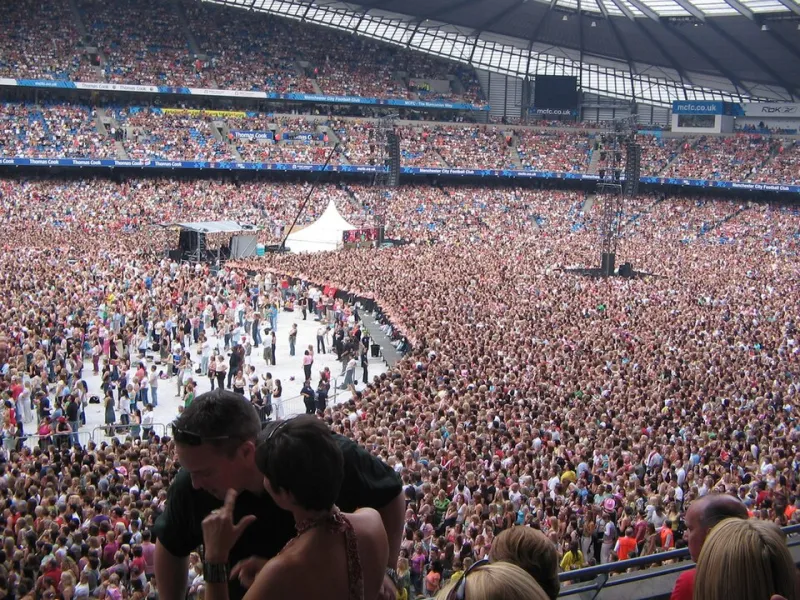
Photo: Sumanah, CC BY-SA 4.0, via Wikimedia Commons
There's a moment every concertgoer knows. You're standing in the merch line — the one that wraps around the concession stand and past the guy selling $9 pretzels — watching the person ahead of you drop $180 on a hoodie, a tote, and a poster that was free at the door last tour. And instead of judging them, you're doing the same math they are: if I don't buy it now, it's gone forever.
Welcome to the merch table economy, where the sticker is $12, the hoodie is $65, and the only difference is about nine dollars of cotton.
The Markup Math Nobody Wants to Do
Let's talk numbers, because someone has to. A blank hoodie costs a merch operation somewhere between $8 and $15 depending on quantity. Screen printing a design runs a few bucks more. So that $65 hoodie you just bought? You're looking at a markup north of 300%, and that's before the artist's cut, the venue's cut (yes, venues take a percentage of merch sales now — it's called a "merch fee" and it's exactly as fun as it sounds), and shipping it all in a truck that follows the tour around like a very profitable stalker.
The sticker, meanwhile, costs pennies to produce and retails at $12. It might actually be the most profitable item on the table per unit. Which raises the obvious question: why does the hoodie cost $65 and not $90? Because the hoodie is the anchor. It makes the $40 tour tee look reasonable. The $40 tee makes the $12 sticker look like a rounding error. It's pricing psychology dressed up in a band logo, and honestly? It works. We've all bought the sticker.
"It's Not a Purchase, It's an Investment"
Talk to enough concertgoers and you'll start hearing the same defense, usually delivered with the confidence of a day trader: tour merch appreciates.
And here's the thing — sometimes they're right. Limited tour drops, city-specific designs, anything printed for a single night at a famous venue — these items flip on resale sites for genuinely absurd money. A hoodie from a surprise one-night show can resell for triple its retail price. This has created a generation of fans who photograph the merch table before the show, cross-reference it against resale listings during the opener, and make their buying decisions like they're reading a stock ticker.
There's a whole taxonomy now. The "grail" (a rare item from a past tour). The "wearable" (something you'd actually put on your body without shame). And the "casualty" (the $50 sweatshirt from 2021 that's been in the drawer since 2021). Every fan you know has at least one casualty. Nobody talks about the casualties.
We Asked a Merch Designer. She Laughed. Then She Talked.
We spoke with a designer who's spent six years creating tour merch for mid-tier pop acts (she asked to stay anonymous, because — quote — "I would like to keep working in this industry"). Her take on the $65 hoodie was refreshingly blunt.
"The hoodie isn't priced at what it costs," she told us. "It's priced at what the fan already decided they'd spend. We know the number before we design anything. The design just has to justify a decision the fan made in the parking lot."
She also confirmed the drop model has invaded merch the same way it took over sneakers. "Everything is 'limited' now. Everything is 'while supplies last.' Half the time supplies are genuinely last! But the scarcity language? That's printed on the signage before we know how many we sold. It's theater. Effective theater."
Her most controversial take: the $12 sticker is, and she chose this phrase carefully, "the honest one." Low cost, high margin, no pretense. "The sticker knows what it is."
The Shameless Cash-Grab Power Rankings
We attended enough shows this year to compile the definitive ranking of the most unhinged items currently sold at merch tables and arena stands across America. Deep breath:
5. The Commemorative Cup. A plastic cup with the tour logo, $18, sold at the bar. You are paying $18 to be allowed to keep a cup. And you will keep it. You will use it for water in your kitchen for four years.
4. The "Vintage" Tee. Pre-distressed, pre-faded, printed to look like you've had it since a tour that ended before you were born. $55 for fake nostalgia.
3. The Vinyl You Already Own. Same album, new cover variant, exclusive to this venue. The music industry discovered the Beanie Babies playbook and refuses to give it back.
2. The Tote Bag That Costs More Than a Real Bag. $35 for canvas and a screen print. You already have 14 tote bags. You will buy the 15th.
1. The Poster Tube. The poster is sometimes free or cheap. The tube — the cardboard cylinder to protect the poster — is $10. You are paying ten dollars for cardboard. And you'll do it again next tour.
So Why Do We Keep Buying?
Because the hoodie isn't really a hoodie. It's a receipt for a night. It's proof you were in the building — a wearable "I was there" that outlives the ringtone-quality videos on your phone. Economists call it a memento; fans call it "the only thing I have from that night besides a hangover."
Is the merch table economy cynical? Absolutely. Will that stop any of us from buying the hoodie and the sticker at the next show? You already know the answer. The sticker knows what it is. So, apparently, do we.
See you in line. We'll be the ones holding the $10 cardboard tube.